A Chain of Camaraderie: Intergenerational Veterans' Networks
On an October day in 2005, Frank Corcoran sat down with historian Dr. Betsy Brinson at the Philadelphia Friends' Center for an oral history interview. Corcoran, a Vietnam War Veteran, had been approached for Dr. Brinson's research on military dissent in light of his extensive activism work with organizations including Veterans for Peace. Over the course of two hours in the Philadelphia conference room, Corcoran traced for the historian and her microphone his winding journey to dissent— probed, prodded, and affirmed along his account by Dr. Brinson.
Near the end of their exchange, Dr. Brinson noted with surprise an unercurrent in Corcoran's narrative which she hadn't anticipated. Corcoran's most visible and outward-facing work— that for which Dr. Brinson herself had approached him— was of challenging the structure, function, and operation of the US Military in organized and institutional ways.
The work, however, that consumed most of his daily life interfaced with another side of the war apparatus in a markedly different way: seeking out and cultivating local resources, opportunities, and programs with the potential to aid young servicemembers transition to civilian life. Dr. Brinson notes to Corcoran that this latent theme of elder veterans' proactive and engaged support of younger veterans has been an underexamined yet recurring theme in the veteran interiviews she has conducted.
This exhibit seeks to more deeply examine this somewhat subversive dynamic: how veterans, particularly those of the Vietnam War, have repurposed the ideals of duty, service, and camaraderie towards building and tending networks of care and community— after and beyond war.
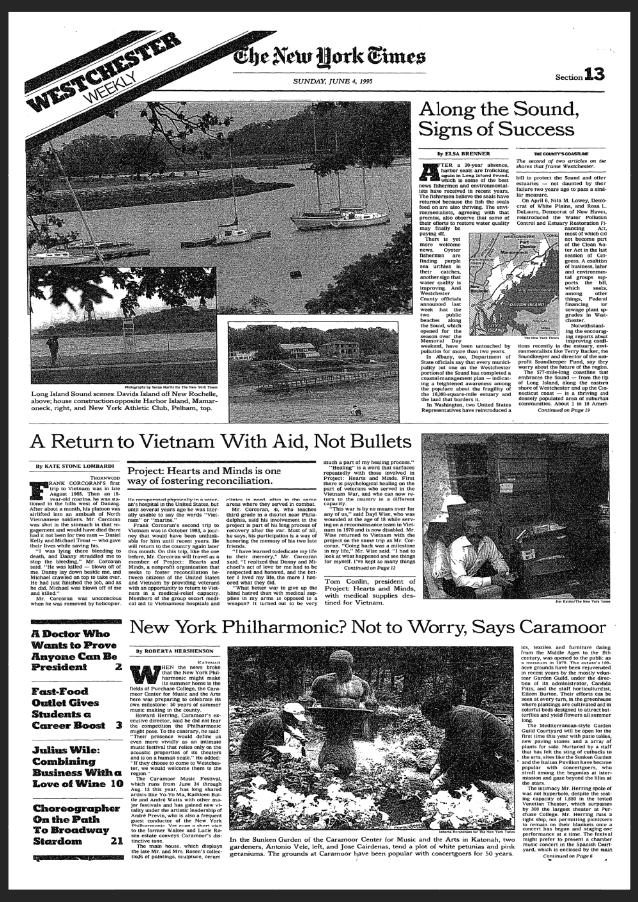
For Corcoran, these efforts to grapple with the moral injuries of war and its attendent guilt included ventures like his 1993 and 1999 returns to Vietnam in medical-releif capacity; an endeavor he and a fellow veteran called "Operation Hearts and Minds."
Other Vietnam Veterans focused their efforts at home: lobbying and advocating for better medical care, representation, and benefits. One such effort began in 1987, when veterans with increasingly serious chronic illnesses and cancers sought answers about their seemingly correlated illnesses. After significant pressure, Congress agreed to investigation into the medical impacts of Agent Orange exposure. The resultant Agent Orange Act of 1991 finally allowed veterans medical benefits for these exposure-induced illnesses.
Corcoran let out a short chuckle as he noted the irony: "The US Government now has to pay me for getting colon cancer because of the Agent Orange they used in Vietnam. And because of that, I'm in a position where I don't need pay. I can afford to help these young veterans. I can give them my time."
Corcoran implores civilians to think more critically about the abstractions of "supporting the troops" beyond displays of yellow ribbons, but as emotional and material support— an endeavor to which he and many of his Vietnam cohort have been committed since their return from Vietnam.
Corcoran's disillusionment with the structure and function of the military has never colored his impression of other servicemembers. He makes clear that individuals touched by war must forevermore negotiate life in terms of survival in deeply personal and interiror ways upon which he has no interest in passing judgement. Rather, what connects them is a structural inadequacy of care and support.
Young veterans returning from Iraq and Afghanistan have especially struck a cord with veterans like Corcoran, as supporting these young folks can be a way to find closure for their own experiences in a war that was similarly controversial and unpopular. These veterans work to ensure that young veterans receive the care and assistance they need when they return home with a unique understanding of need and impact.
Many Vietnam era veterans have cited the opportunity to channel feelings of frustration and anger into a positive force that benefits others who have faced similar challenges as propelling their work. Research has found that engaging with Iraq War veterans in mentorship capacities has helped Vietnam War veterans to overcome feelings of isolation and disconnection common in transitioning back to civilian life. Through sharing their stories and experiences, many have found a sense of belonging and connection with others who understand what they've been through.
Just as Vietnam War veterans have found healing and purpose in supporting and engaging with young veterans, Iraq War veterans benefit from the guidance and wisdom of their older counterparts who provide valuable insights into navigating the complexities of the VA healthcare system, accessing resources, and dealing with the emotional tolls of combat.
The bond of shared military experience and commitment to service has created a deep connection between these groups of veterans, resulting in a powerful network of trust and care. Accordingly, these bonds are a powerful force for healing and support, and serve as testament to the enduring strength and resilience of the military community.
Raw numbers of veterans in each state are a valuable metric for understanding the absolute size of the veteran population in a given area. These insights are sought in determining the potential demand for veteran services and resources and guide policymakers in fund and resource allocation decisions. Conversely, the percent of state population that are veterans is a valuable metric to standardize population data and make comparisons across different states with varying population sizes to determine disproportionately large concentrations of veterans in certain regions. It is important to consider both metrics in order to gain a more complete picture of the veteran community in a given area.
The four states where the number of veterans as a share of the adult population exceeds 10% Alaska, Montana, Virginia, and Wyoming. With the exception of Montana, each of those states is home to one of America’s largest military cities:
Fairbanks, AK: Fort Jonathan Wainwright
> Military members & families: 21,037 (20.9% of pop.)
> Veterans: 12,196 (12.1% of pop.)
Virginia Beach, VA: Norfolk Naval Base
> Military members & families: 223,157 (12.9% of pop.)
> Veterans: 232,704 (13.5% of pop.)
Concentrations of veteran populations, though, not substantially different between Vietnam-Korean Conflict-and pre 9/11 Gulf-War-Veterans and post 9/11 Gulf-Afghanistan-and-Iraq War Veterans do reveal some interesting changes.
Oregon and Minnesota have the highest share of veterans who served during the Vietnam War era, both topping 40% of the states' veteran populations.
Veterans of the first Gulf War era (1990-2001) are highly concentrated in Virginia and Alaska, with 33.9% and 31.5% of living veterans from that era, respectively.
With 7.1%, Connecticut is home to the highest percentage of veterans from World War II
Codifying Networks by Maitreyee Singh
An estimated 500,000-700,000 Vietnam veterans still suffer from post-traumatic stress disorder; characterized by mental flashbacks of the war, recurrent dreams of the trauma, repetitive, intrusive thoughts of the war, irritability, generalized anxiety and difficulty relating to others. Though comprehensive percentages vary greatly because of the difficulty of assessing nondiagnosed Vietnam Era veterans, estimates range from 10-30% of these Veterans suffering from the condition at some point upon their return. On average, 20% of Iraq and Afghanistan War Veterans are expected to experience PTSD during their lifetimes.
From late 1970 through late 1974 New York City veterans held rap sessions (shorthand for 'therapy'), attended by over 200 veterans. Assisted by volunteer therapists the groups met weekly and offered a unique opportunity to explore the meaning of the veteran experience in a therapeutic context. For many years, these individuals' PTSD went undiagnosed and, except for rap groups, untreated.
The rap groups were formed to talk about the war in a general debriefing process during the early 1970s, and though these rap groups often failed to focus on the individual pathology, they provided an invaluable forum to refashion value and meaning in the veterans' lives.
Today, more traditional forms of group therapy have been used to help treat individuals suffering from posttraumatic stress disorder. There have been several studies conducted on the benefits of peer support among veterans, which includes the healing process that can occur when veterans support other veterans. A 2016 study published in the Journal of Traumatic Stress found that veterans who engaged in peer-to-peer support reported significant decreases in symptoms of PTSD and depression. Another study published in Military Medicine in 2015 found that veterans who participated in a peer mentorship program reported greater satisfaction with their healthcare and improved mental health outcomes.
Additionally, a 2017 study published in the Journal of Interpersonal Violence found that veterans who engaged in peer support programs were less likely to engage in aggressive behaviors and experienced fewer symptoms of trauma-related distress. These studies are two among a growing body of empirical evidence for the mutually beneficial impact of intergenerational mentorship initiatives in veteran readjustment.
A considerable debt of gratitude is owed to Frank Corcoran for his forthcomingness and vulnerability in this interview. This exhibit neither intends to, nor could, capture the full texture and weight of his story. It is merely an examination of one condition of US Veteran experiences. The narrative Corcoran shared in its entirety is a compelling and deeply worthy listen on its own merits for the insightful, explorative, and gracious prespectives offered.
Another equally important thanks must be extended to Dr. Betsy Brinson for her work in conceiving of and conducting invaluable projects of historical preservation. Dr. Brinson's gracious gift of this collection of oral history interviews to the Southern Oral History Program's Interview Database allows public access to and engagement with stories to which we would not otherwise have access.
Footnotes
- ^ Burns, Ken. "Fellow Warriors: Vietnam, Iraq, Afghanistan" Arlington, Virginia : PBS. September 28, 2017.
Cathy Shufro, “The Unseen Wounds of War,” Yale Medical Magazine, no. Autumn 2005 (September 15, 2005): 24–27, https://medicine.yale.edu/news/yale-medicine-magazine/article/the-unseen-wounds-of-war/.
“Vietnam Veterans Help Iraq Vets Through Transition,” All Things Considered by Alison St. John (San Diego, California: NPR, February 18, 2007).
David Flores, “Politicization Beyond Politics: Narratives and Mechanisms of Iraq War Veterans’ Activism.” Armed Forces & Society, 43(1), 164–182: 2017. https://doi.org/10.1177/0095327X16642041
Jessica L. Adler, “The Activism of Military Veterans Spans the Political Spectrum.” Washington Post, November 11, 2022. https://www.washingtonpost.com/made-by-history/2022/11/11/veterans-activism/.
Jennifer MIller, “Vietnam Veterans Help Returning Iraq Soldiers Deal with Shocks of War.” (The Christian Science Monitor, January 30, 2008), https://www.csmonitor.com/USA/Military/2008/0130/p20s01-usmi.html.
Chris Farrell, “Two Military Veterans Help Other Vets Transition to Purposeful Civilian Life,” Next Avenue (Next Avenue, November 11, 2021), https://www.nextavenue.org/military-veterans-transition-to-civilian-life/.
Jain S, McLean C, Adler EP, Rosen CS. "Peer Support and Outcome for Veterans with Posttraumatic Stress Disorder (PTSD) in a Residential Rehabilitation Program. Community Mental Health" J. 2016 Nov; 52(8):1089-1092. doi: 10.1007/s10597-015-9982-1.
Hall, S., Flower, M., Rein, L., & Franco, Z. (2020). "Alcohol Use and Peer Mentorship in Veterans." Journal of Humanistic Psychology, 0(0). https://doi.org/10.1177/0022167820905952
Van Voorhees EE, Resnik L, Johnson E, O'Toole T. "Posttraumatic stress disorder and interpersonal process in homeless veterans participating in a peer mentoring intervention: Associations with program benefit." Psychol Serv. 2019 Aug;16(3):463-474. doi: 10.1037/ser0000231.
Frank Geraci "Trained, Peer Mentorship and Veteran Support Organization Membership to Assist Transitioning Veterans: A Multi-arm, Parallel Randomized Controlled Trial" 2016 https://pubmed.ncbi.nlm.nih.gov/26839108/ doi: 10.1007/s10597-015-9982-1.
Jean Yoon, Jeanie Lo, Elizabeth Gehlert, Erin E. Johnson, Thomas P. O'Toole "Homeless Veterans’ Use of Peer Mentors and Effects on Costs and Utilization in VA Clinics." Feb 2017 https://doi.org/10.1176/appi.ps.201600290
"Peer Advisors for Veteran Education (PAVE): Implementing a sustainable peer support program for student veterans on college campuses" DOI: https://doi.org/10.18060/21541 2017-08-24 Vol. 28 No. 3 (2017): Student Peer Mentoring
Mercier, Jean-Michel, Fardous Hosseiny, Sara Rodrigues, Anthony Friio, Suzette Brémault-Phillips, Duncan M. Shields, and Gabrielle Dupuis. 2023. "Peer Support Activities for Veterans, Serving Members, and Their Families: Results of a Scoping Review" International Journal of Environmental Research and Public Health 20, no. 4: 3628. https://doi.org/10.3390/ijerph20043628
Gorman, J. A., Scoglio, A. A. J., Smolinsky, J., Russo, A., & Drebing, C. E. (2018). "Veteran Coffee Socials: A community-building strategy for enhancing community reintegration of veterans." Community Mental Health Journal, 54(8), 1189–1197. https://doi.org/10.1007/s10597-018-0288-y
Drebing, C. E., Reilly, E., Henze, K. T., Kelly, M., Russo, A., Smolinsky, J., Gorman, J., & Penk, W. E. (2018). "Using peer support groups to enhance community integration of veterans in transition." Psychological Services, 15(2), 135–145. https://doi.org/10.1037/ser0000178
Jain, Shaili, Caitlin McLean, and Craig S. Rosen. "Is There a Role for Peer Support Delivered Interventions in the Treatment of Veterans with post-traumatic stress disorder?." Military Medicine 177, no. 5 (2012): 481.
Scurfield, Raymond M., Teena M. Corker, Patricia A. Gongla, and Richard L. Hough. “THREE POST-VIETNAM ‘RAP/THERAPY’ GROUPS: AN ANALYSIS.” Group 8, no. 4 (1984): 3–21. http://www.jstor.org/stable/41718251.