June Lee and Immigrant Experiences in the U.S. Military
Item set
- Title
- June Lee and Immigrant Experiences in the U.S. Military
- Creator
- Sonia Rao
Items
14 items
-
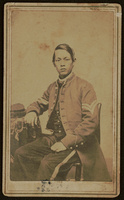
[Corporal Joseph Pierce of Co. F, 14th Connecticut Infantry Regiment in uniform] / W. Hunt, photographer, 332 Chapel St., New Haven, Conn.
Photograph shows identified Chinese American soldier. -
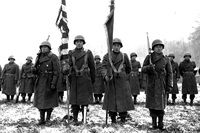
442nd Regimental Combat Team
Soldiers of the 442nd Regimental Combat Team, an all-Japanese-American military unit during WWII, stand on the ground at Bruyeres, France. -
A Pakistani recruit, 22, who was discharged from the U.S. Army in 2018.
A Pakistani recruit, 22, who was discharged from the U.S. Army in 2018. -
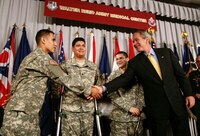
Bush presides over soldiers' citizenship
President George W. Bush congratulates (L-R) Spc Sergio Lopez, Spc Noe Santos-Dilone and Pfc Eduardo Leal-Cardenas after they were sworn-in as American citizens. -
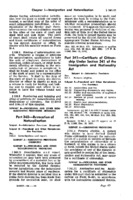
Code of Federal Regulations: Certificate Of Citizenship Under Section 341 Of The Immigration And Nationality Act, 8 C.F.R. (1952)
Code of Federal Regulations, Title 8: Aliens And Nationality, Chapter I: Immigration And Naturalization Service, Department Of Justice, Part 341: Certificate Of Citizenship Under Section 341 Of The Immigration And Nationality Act, Revised 1952 -
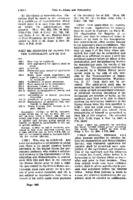
Code of Federal Regulations: Registry Of Aliens Under Nationality Act Of 1940, 8 C.F.R. (1941)
- Description: Code of Federal Regulations, Title 8: Aliens And Nationality, Chapter I: Immigration And Naturalization Service, Department Of Justice, Part 362: Registry Of Aliens Under Nationality Act Of 1940, Revised 1941 -
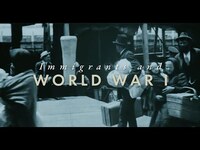
How WWI Changed America: Immigrants and WWI
In World War I, one out of every five soldiers in the U.S. Armed Forces was an immigrant. For some it was a path to citizenship. For the nation it proved pivotal to a more inclusive definition of “American.” This video is made possible by a grant from the Andrew W. Mellon Foundation and is a partnership of the U.S. World War One Centennial Commission, the Doughboy Foundation and the National WWI Museum and Memorial as part of the teaching and learning resources of “How WWI Changed America.” View all the resources from “How WWI Changed America” at https://wwichangedus.org Have questions? Email us at education@theworldwar.org and for more information about the National WWI Museum and Memorial visit https://theworldwar.org -
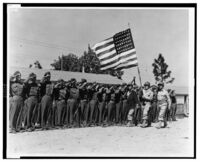
It's "Present arms!" for members of the 442nd Combat Team, Japanese-American fighting unit, as they salute their country's flag in a brief review held the day of their arrival at Camp Shelby, Miss.
It's "Present arms!" for members of the 442nd Combat Team, Japanese-American fighting unit, as they salute their country's flag in a brief review held the day of their arrival at Camp Shelby, Miss. -
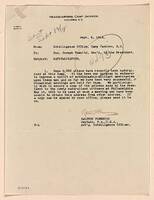
Letter in which Captain Ralston Flemming writes of his desire to instill a spirit of “militant Americanism” among immigrant soldiers.
This letter by U.S. Army Captain Ralston Flemming from 1918 is about the efforts at Camp Jackson in South Carolina to assimilate immigrants into the American military. Some time after this letter was written, Congress passed legislation that alowed foreign-born soldiers to obtain expedited naturalization. About 300,000 immigrant soldiers gained citizenship through military service in the war. -
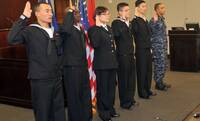
MAVNI
Sailors who participated in the Military Accessions Vital to National Interest program are issued the oath of citizenship. -
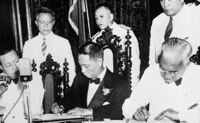
Military Bases Agreement
Philippine President Manuel Roxas and U.S. Ambassador Paul V. McNutt (right) sign the Military Bases Agreement in Malacanang Palace, surrounded by onlookers, including Philippine Vice President Elpidio Quirino (far left). -

N-0072 Interview with June Lee
Abstract June Lee is an Asian American, U.S. Army veteran based in North Carolina. She was interviewed not only because of her experience as a veteran but also because of her positionality as an Asian female within a predominantly white, male environment. She began by describing her upbringing in Seoul, South Korea and subsequent move to the U.S. as a teenager. Lee explains that the transition was difficult because of language and cultural barriers. After turning 21, Lee looked for ways to obtain U.S. citizenship representing another difficult period in her life. Lee’s family pondered over whether she should return to Korea or stay in the U.S. They decided she should obtain international student status at UCLA. After, she explains how college was difficult, not knowing whether her decisions in college came from her desires or her parents’ wishes. After college, Lee looked for routes to citizenship explaining why she joined the Army. She received expedited citizenship in exchange for military service through a program called MAVNI. Thereafter, Lee describes her basic training at Fort Jackson in South Carolina and how the experience was difficult but not overwhelming. She was trained to be a food inspection specialist. She also completed administrative tasks and worked with special operations. Lee describes feeling insecure about parts of her military experience, because MAVNI did not have a well-defined structure for the program’s active-duty members. Her first assignment was to Fort Bragg in North Carolina. Next, Lee describes the food she ate and the music she listened to during service. Neither made too large of an impression on Lee, but images of trees and swamps did. Thereafter, the conversation moves to Lee’s experience as both an Asian and Asian women in the Army. She notes how MAVNI participants included many other Asians, so her Asian identity did not stand out; however, Lee’s Asian womanhood was pronounced. She explains how people outside of Fort Bragg viewed Lee as an army wife because many military members had Korean wives. Lee explains how she pushed herself to fight the view that she was a dependent, Korean female. Lee notes that she had a sense of disdain for these wives because of the ease and perceived illegitimacy in their paths to U.S. citizenship when she faced strife in that process. She describes feelings of pride at her boot camp graduation but was not particularly happy in the military. Lee then explains not wanting to stay in the military past her appointment and her natural transition to civilian life. Thereafter, Lee notes that she was married before her service, but that she did not want to receive citizenship from her husband. After the military, they got a divorce. As a civilian, Lee has applied organizational discipline to her daily life. Lee concludes by detailing a lesson from her time in the military, not stereotyping and labeling people based on external characteristics - something she aims to incorporate in her present life. This interview is part of the Southern Oral History Program’s project to document veterans’ experiences in North Carolina. -
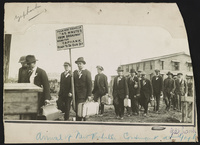
The arrival of the New Rochelle contingent at Camp Upton, Yaphank / Photograph by F.M. Stefano, Herald photographer.
Photograph shows procession of men arriving for military service at Camp Upton, one carrying a sign stating: "From New Rochelle, '45 minutes from Broadway,' bound for Yaphank. Ready to do our bit." -
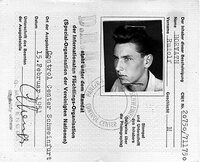
The ID card issued to Rudolf G. Horvath by the Displaced Persons (DP) Center located in Panzer Kaserne in Schweinfurt, Germany in 1951.
The ID card issued to Rudolf G. Horvath by the Displaced Persons (DP) Center located in Panzer Kaserne in Schweinfurt, Germany in 1951.